10 Ways To Improve Medical and Dental Practice Profitability

The following is an article I wrote for MGI South Queensland. MGI is a global consulting and accounting firm.

Despite a reputation for being some of the best paid professions in Australia, there is no guarantee that medical and dental practices will make money. In fact, one survey showed that 20% of medical practices make losses.1 Having worked with many medical and dental practices, both general and specialist, here are 10 ways we think practice owners can improve their profitability.

Practice


1. Do you have to do it?

Leverage is the name of the game. The effective use of nurses and administration staff is a key area where practices should look to improve their profitability. This is also an area where there is a great deal of difference between practices. For general medical practices, we think clients should aim for one administrative staff (other than the practice manager) per 2 GPs and 1 nurse between 4 to 5 GPs.2 On average, non-GP staff cost is 23% of gross patients, but the top 20% manage to operate on just under 15%. For dental practices, the average is 30% (this includes dental assistants and hygienists) but some manage under 20%!

2. Are they coming back?

One of the biggest challenges for the doctors and dentists we work with is getting patients to come back. Many practices have invested time and money in setting up systems to remind patients to come back for a check-up. For us accountants, there’s Big Brother (the tax office) with a stick that “reminds” everyone when it’s tax season. Getting high reappointment rate at your practice, however, requires a lot more work than an automated reminder. The benefits are significant though. Analysis of dental practices show the biggest difference between practices that make $500k in patient fees and those than make $1m is reappointments for regular check-ups. And we all know it is a lot more expensive to get a new patient to pay you a visit than an existing one.

The key to getting patients to come back is to have you, the practitioner, explain to your patient why it’s important to come back for a check-up. I know, I know, the pressure to move onto the next appointment can sometimes be immense. But hear me out. Your patients are there because they trust you with what they value the most, their own bodies. So you are by far the best placed person to explain to them the importance of regular check-ups. Only when you take the time to explain, will they perceive enough value in the regular check-up to warrant them to come back. So by all means investing in automated reminders, but also take time to explain to your patients the benefits of regular check-ups (e.g. overall health benefits, avoiding emergency appointments, early detection of issues, I’m sure you know them way better than I do).

3. Would you like fries with that?

This iconic phrase of McDonald’s has now become synonymous with up-selling. Whilst many of us may be reluctant, being able to up-sell is an essential skill for any business owner. There are many businesses that depend on the up-sell to make a buck. You know the ones I’m talking about: a free book that leads to an offer about another (a cheap book). You are then offered a (slightly more expensive) course, which leads to a seminar which up-sells to a $20k “mastermind” workshop.

Applying a similar strategy for our dentist friends, you could offer say, a free tooth clean in your marketing. Remember the most expensive sale is the first sale. It is worth investing some time to get them in the door. Once they are in, you know what to do: depending on what they need, subtly offer them whitening, filling, cosmetics, crown etc. Work your way up the value chain for your practice. And don’t forget the previous point, make sure they come back and measure your reappointment rate.

4. Beware of benchmarking!

This might rile some of my fellow accountants up a little. If your accountant is worth their salt they would have sent you some industry benchmarks for your practice. And we are all for benchmarking (call us if you’d like to benchmark your practice against your peers). It is an easy way to access where you are compared to your peers. The idea is that you can get the most bang for buck for your efforts in the areas with large dollar impact and where you are most behind.

Be warned, there is a trap with benchmarking: you need someone experienced with the numbers to figure out what the numbers are saying that you should do.

Back to medical practices. To give an example, according to a recent survey, the industry average of gross patient fees for a GP is approximately $400k. The top 20% generated over $590k per annum. The same survey says 60% of those fees are bulk-billed. But the top 20% bulk bill 91% of the fees. On the surface, increasing bulk-billing percentage might seem like a valid strategy. However, there’s actually no definitive link between bulking billing and the profitability of the practice. As the saying goes, Sales is Vanity, Profit is Sanity and Cash is Reality. If it doesn’t turn into profit and cash in your pocket, all you are doing is stressing yourself out with increased activity. Don’t get me wrong, I’m not saying increasing your bulk-billing percentage is never a good idea. This will depend on a number of factors, not least the demographics of surrounding suburbs. What I’m saying is that it is worth bearing in mind that often practices that only or mostly bulk bill will have lower profit margins than private practices. As a result, there’s often a lot more pressure put on the doctors of bulk billing practices to have shorter appointments, something not necessarily the best for patient care. But it may be necessary for practice survival.

A better metric to measure, in our opinion, is how well the consulting rooms are utilised. One study found the average consulting room usage is 49.3%. This means half the time the practice is open, nothing’s happening in those rooms! The best practices manage 75.1% on average.

Beware of benchmarks and make sure your accountant understands the drivers of profitability in your practice.

Financials

5. Focus on the North Star Metric

If you’ve ever been to a business awards night, you’ll hear stories of astronomical growth and heroic tales of overcoming obstacles to conquer the world. If you ever read the financial press, you’ll read about the insane profits the big banks make. Amidst the glamour, glitz, shock and awe, rarely will you hear the rational (accountant) voice that everyone’s forgetting what matters the most – return on investment. It is not cheap to start and run a practice (something our dentist friends understand the most I suspect). How do you know if you’ve made enough money to compensate the time and effort as well as the risks you’ve taken? Our answer, measure, measure and always measure your return on investment. More specifically, measure Return on Capital Employed which is the most important measure of financial performance for any business. Not just for the business, the same principle applies to every marketing campaign and buying new practice equipment.

6. How much does the alternative cost me?

Running a business is about making decisions, big and small, day in and day out. One of the questions asked when making decisions is: how much is it going to cost me? What is often not asked, though, is: what does the alternative cost? It is worth comparing the costs and benefits of alternatives.

For example, some practitioners prefer to hire casual staff rather than permanent staff. It is rare though, for the practitioner to how work out the costs of benefits of employing casual versus permanent staff. The comparison it not straight-forward. A permanent staff member is entitled to leave (annual, personal and long service) whilst a casual staff isn’t. But a casual staff member gets an uplift in pay (typically 25% under most of the relevant awards) to compensate for this. Whilst this depends on the practice and the roles filled by those staff, it is often the case that the practice may save money by replacing casual staff by permanent staff. This might come as a surprise to some and it is worth thinking about how you’ve structured staffing.

7. I didn’t make any money so why do I need to pay tax? Watch the cash.

When we present financial statements to clients, it is not unusual to see clients say that whilst they understand they’ve made a profit, it doesn’t feel like it and no one wants to pay tax when they don’t have the cash.

Cash flow management is often an overlooked area in business. For our practice clients, we see this issue most often with our orthodontist clients, although it is an area that needs monitoring by all. DentiCare is great in getting patients over the line to getting treatment, but spreading receipt for patient fees over two to three years will put strain on your cash flow. It is therefore important to befriend your bank manager and your accountant (yes accountants need friends too) to:

  1. Monitor and forecast when you might need help with cash flow
  2. Warn your bank manager so they are not taken by surprise.

Early detection and warning is crucial. After all, there is only one reason why businesses go broke – running out of cash.

Strategy

8. Don’t forget your most valuable asset

Being some of the best paid professions in Australia, the vast majority of medical/dental practices are profitable.You’re no doubt inundated with requests to invest your hard-earned money in all sorts of investments: bonds, TDs, shares, property, precious metals, Bitcoins etc. etc.

You may or may not have thought about what your most valuable asset (other than your home) – your practice, is worth. Especially given the recent trend in consolidators buying practices, this is becoming something at the forefront of more practitioners’ mind.

Practice valuation is not a simple exercise but it doesn’t have to cost an arm and a leg either. If you want to know how much your practice is worth, download our business valuation guide or come and talk to us. If you aren’t happy with the current value of your practice, a good place to start is to re-read this piece and start implementing some changes. By all means come and talk to us if you want help.

9. Get advice

Doctors and dentists are some of the busiest people. Pressure of back-to-back appointments often makes it difficult for you to take time out to seek advice from other professionals who can help you. In order to grow your wealth, getting the structuring of investments right can protect your assets as well as potentially saving you hundreds of thousands in tax. Working on your business is just as important as working in your business. So when your professional advisors want to meet for a meeting, say yes! A good professional will be accommodating of your schedule.

Read the story of how we’ve helped a orthodontist throughout his entrepreneurial journey.

10. What is your end game? Visions of the not-too-distant future.

What does your life look like in 5, 10 or 20 years’ time? Where will you live? What will you do? What does family life look like? What does your social life look like? What will give your life meaning?

“Begin with the end in mind”, says Stephen Covey in his brilliant book, ‘Seven habits of highly effective people‘. When you are in the midst of things, it’s easy to miss the forest for the trees. Be sure to take some time out to plan what your future will look like. You’ll find this will inform what you should be doing now and what changes you might want to make to get there.

Footnotes:
1. As compared to if that practitioner was in a job rather than owning a business.
2. All full time equivalents.
Read Before You Buy: Detailed Review of Sam Ovens’ Consulting Accelerator

I don’t like reviewing, especially products with lots of review already (over 3,000 on the consulting.com website). But today I want to make an exception.

Over the last a few months I’ve gone through this course myself (bought it at full price). It claims to be the best and comprehensive training for consultant, no matter what your level of experience is.

Like many people who attended the webinar (pre-recorded, by the way), it felt too good to be true. But I bit the bullet, bought the course and here’s a honest, week by week review of the product.

What is this Consulting Accelerator thing?

If you happen to stumble onto this page by chance, this is the product I’m talking about (btw I’m not an affiliate so I don’t get paid when you click). By the way the “everyday price” never changes, it’s always $1,997 (USD).

As you can see from big bold heading on the page, the course claims to teach you “How to start a wildly profitable 6-figure consulting business & get your first high value client in 42 days”.

So let’s take a dive into it and see what it contains and whether it lives up to its claim.

Once you sign up, pay and log in, this is what you see.

Welcome.PNG

I must say, having bought courses that were delivered over platforms like Kajabi, it’s a pleasant surprise to see someone who spends the time and money to develop their own delivery platform.

It is very professional-looking and navigation is intuitive. All videos are in full HD and Sam Ovens personally talks over all of them. The downloads are easy to access. All in all, the platform is excellent and no doubt Sam Ovens will think about monetising it sometime down the track.

But you don’t really care about the platform design, you care about whether the course has the goods. Let’s walk through week by week.

Week 1 – Fundamentals and Foundations

W1

This week starts off pretty bland by explaining what a consultant is. If you’re interested in doing businesses online you’ve probably have seen it before. Sam Ovens designs the course with the expectation that some students will know nothing about businesses at all so this is understandable. I found the first few videos a bit draggy. The video player allows for up to 2x the speed so I used that a few times. Sam talks slow enough for that.

It gets good pretty fast and the last few videos of the weeks talks about picking niches and crafting a message. He has a couple of free videos on picking the niche so check those out if you want to get a flavour.

He gives some solid advice, especially for those starting out in business. I work with many businesses and one of the first things business owners need to learn is explaining to others what the heck they do. I found some bits very long-winded (most videos are between 1 to 2 hours). But it’s important and Sam states the same things a number of times.

I would rate this a solid 3.5 out 5 as it has good, essential bits for consultants but way to long winded in my opinion.

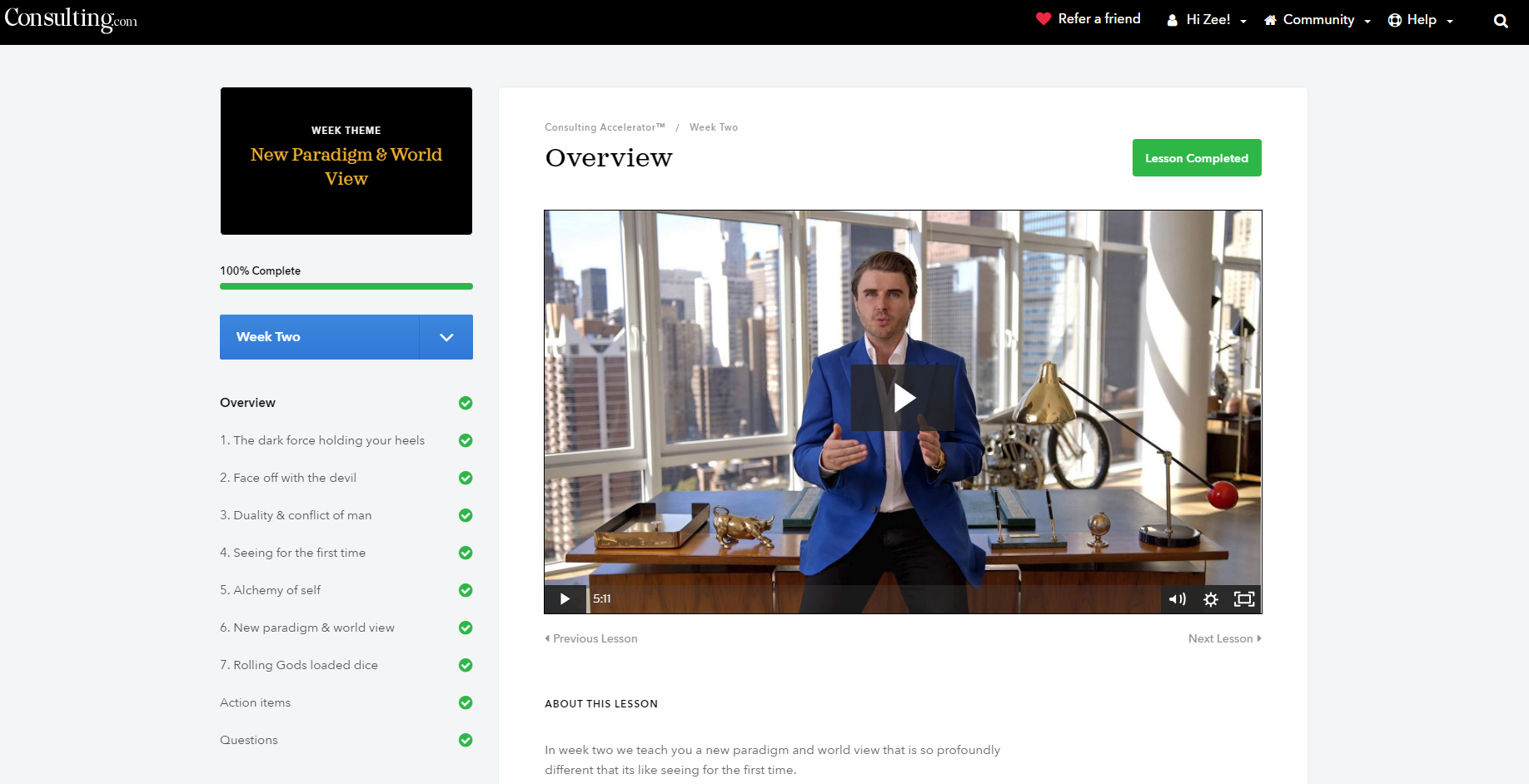
Week Two: New Paradigm & World View

W2

This is the week about mindset.

Now depending on where you are at in your journey, you may or may not appreciate the importance of mindset. Personally I’m convinced working on one’s mindset if vital for success, in any area of life. This includes business and the most successful business people I know are the most resilient, positive people I’ve ever met. So I’m really glad that Sam includes a significant chunk of the course on mindset. Don’t get me wrong, the most important thing in my opinion is taking actions. But mindset is almost just as important.

Sam shows his introverted side in this week and take a philosophical approach. He is very interested in what people do and why people do them. If you are interested in these topics, philosophy and psychology, you’ll enjoy this week. Although again some part are long-winded and repetitive.

Before this iteration of the course, it didn’t have this week on mindset and Sam found amongst his students mindset made a huge difference in whether they are successful, how quickly they give up etc. I applaud Sam to including this in the program. His template for creating a vision board (he calls it the “Alchemy of self”) is very fun. I can imagine many people find enough value in this week to justify the price of the course but heavily depends on where you are at. Most people though I think will think this week is so-so.

I’d give this week a 4 out 5 as mindset is so important and is second only to taking action. It loses the 1 point as again, the videos are too long. So I suspect you’ll be using the 2x button multiple times.

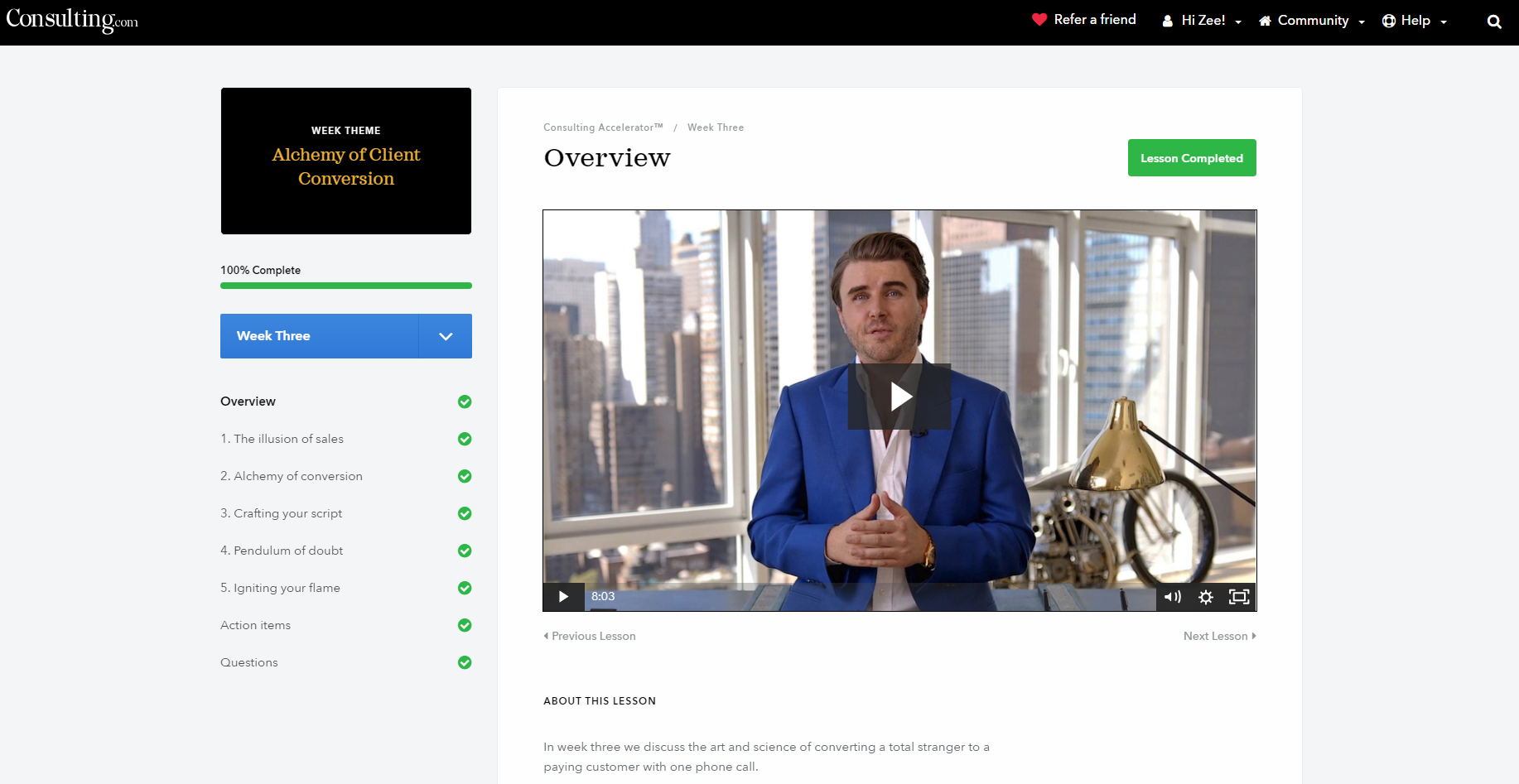
Week Three: Alchemy of Client Conversion

W3

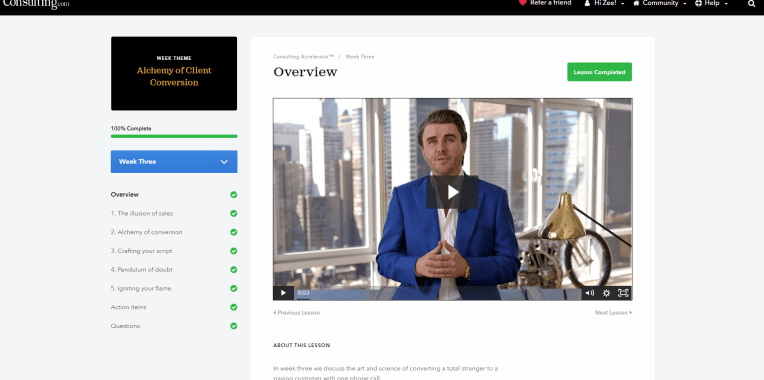
This week is all about selling. The 2 big challenge in businesses often are sales and HR. And this week is so good that it definitely deserves a 5 out 5. Sam gives you his script and walks through it page by page. The videos are not short but is jam-packed with Sam’s experience from selling to thousands of people on phone and tens of thousand over the Internet.

If you are not convinced that sales is the most important skill in business, you won’t find much value in this course. But if you are, like me, you’ll be going back to this week again and again to soak in many of the valuable tips Sam provides. He doesn’t just teach sales (many people do that and do that well). He packages this training with actionable steps that, when implemented, can turn anyone into a great salesperson. This is probably best part of the course (I say probably because the FB training is amazing, but more on that later).

Let me say that again, he doesn’t just provide sale training. Instead he provide step by step instructions on what to do.

Did I say this week gets 5 out 5?

At the time of writing this review. Sam provides $500 discount on the course. If you want to sign up, drop me a line here and I’ll save you $500.

Go back

Your message has been sent

Warning
Warning

Warning.


Week Four: Alchemy of Client Attraction

W4

Peter Drucker says business is all about marketing and innovation. If this is the case, this section and Week Five contains 50% of what makes up a successful business.

Even though these two weeks in about one thing, I’ll review Week Five separately. One because it is a separate week, another because it is just so special.  

I do find it a little strange that this week is after Week Three, because this is the week that Sam teaches how to organically find clients. You’d think that Week Three should follow this week so after we’ve scheduled in some strategy sessions. Strategy sessions are a fancy way of saying telephone/video appointments.

In this week, Sam teaches a complete system in detail (the same one he shows in the webinar). It includes:

  • Facebook posts
  • Direct email outreach
  • Lumpy (physical!) mail
  • List farming
  • JV webinar with someone serving a similar niche
  • Facebook ads at a high level (Week Five is all about Facebook ads)
  • The fragmentation funnel (value video, survey, call etc.)
  • Setting up stripe/payment system
  • Legal documentation

Sam is incredibly thorough in explaining all of the above methods. If you follow his instructions step by step, you will have a sales funnel in place.

Let me stress that Sam does this in simple language and what you have is a working funnel that many people have paid thousands of dollars for. Sam doesn’t appear to have any interest in selling additional training/products whatsoever until you’ve successfully launched your business and has clients. In fact, at the time of writing, he let you use his settings, ad examples and web site templates to launch your own, which is incredible value when you think about it. Most people would pay an additional fee for this.

I’d give this week 4.5 out of 5. I wish he explains in more detail the process of making video sales letters and devote one video to copywriting.

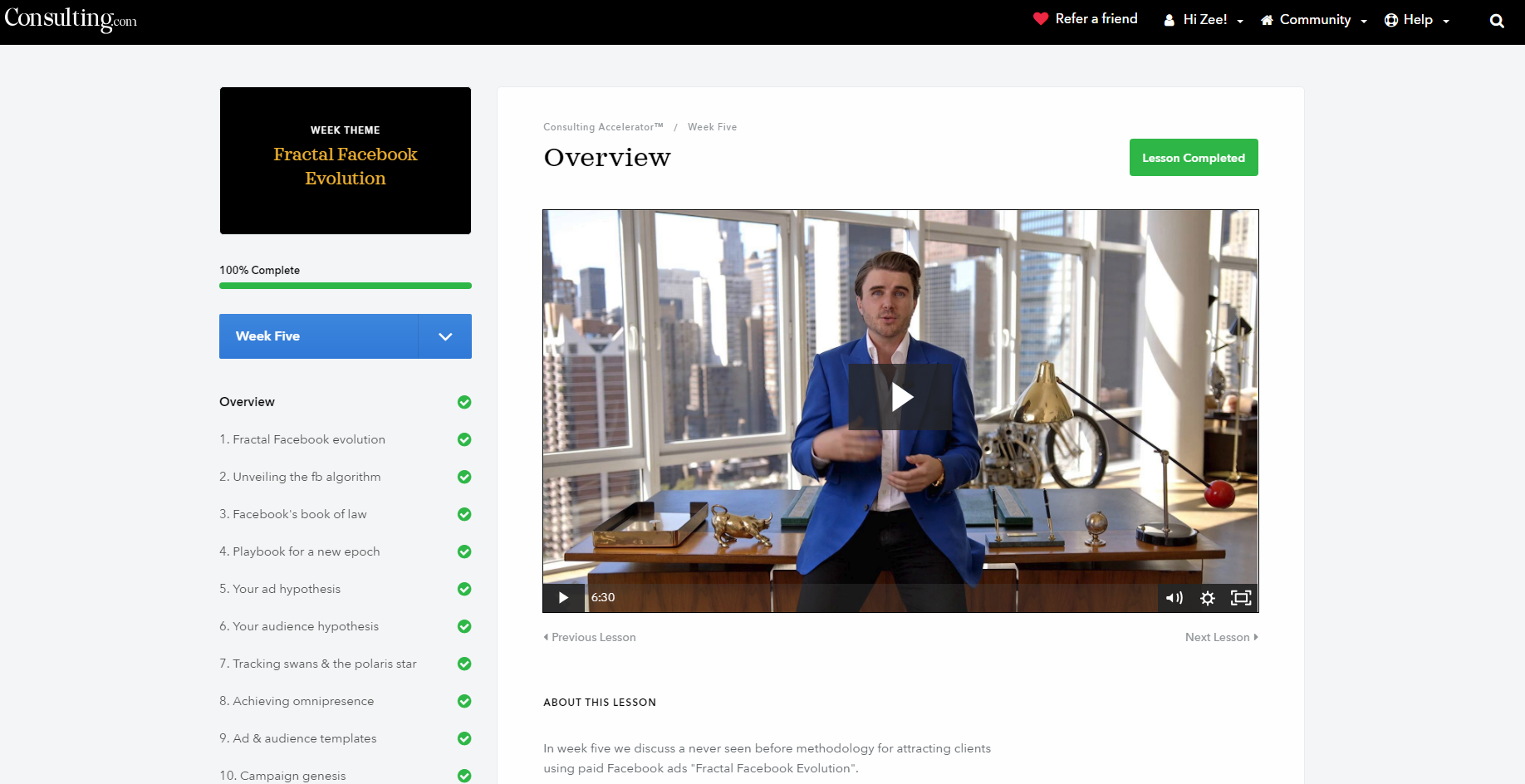
Week Five: Fractal Facebook Evaluation

W5

There’s over 24 hours of video training in this week. You read that right, over 24 hours. And all of is gold. Like I’ve read elsewhere, I agree that this could be a separate program by itself and command the $1,997 by itself. Why?

First, Sam shows step by step what he does in minute detail. You don’t have to figure out how to do anything yourself. He even shows which buttons to click on what page to set the ads up.

Second, he painstakingly explains the macro strategy behind Facebook ads and you are left with no doubt he knows exactly why he’s doing each step. His understanding of the Facebook algorithm is unlike any other I’ve heard. He knows exactly how Facebook’s algorithm works at a functional level.

Third, almost nobody has had the success through Facebook ads like he has. Having spent millions and millions of dollars on ads, I don’t doubt at all he knows how to build and scale Facebook ads that make money.

A definite 5 of 5.

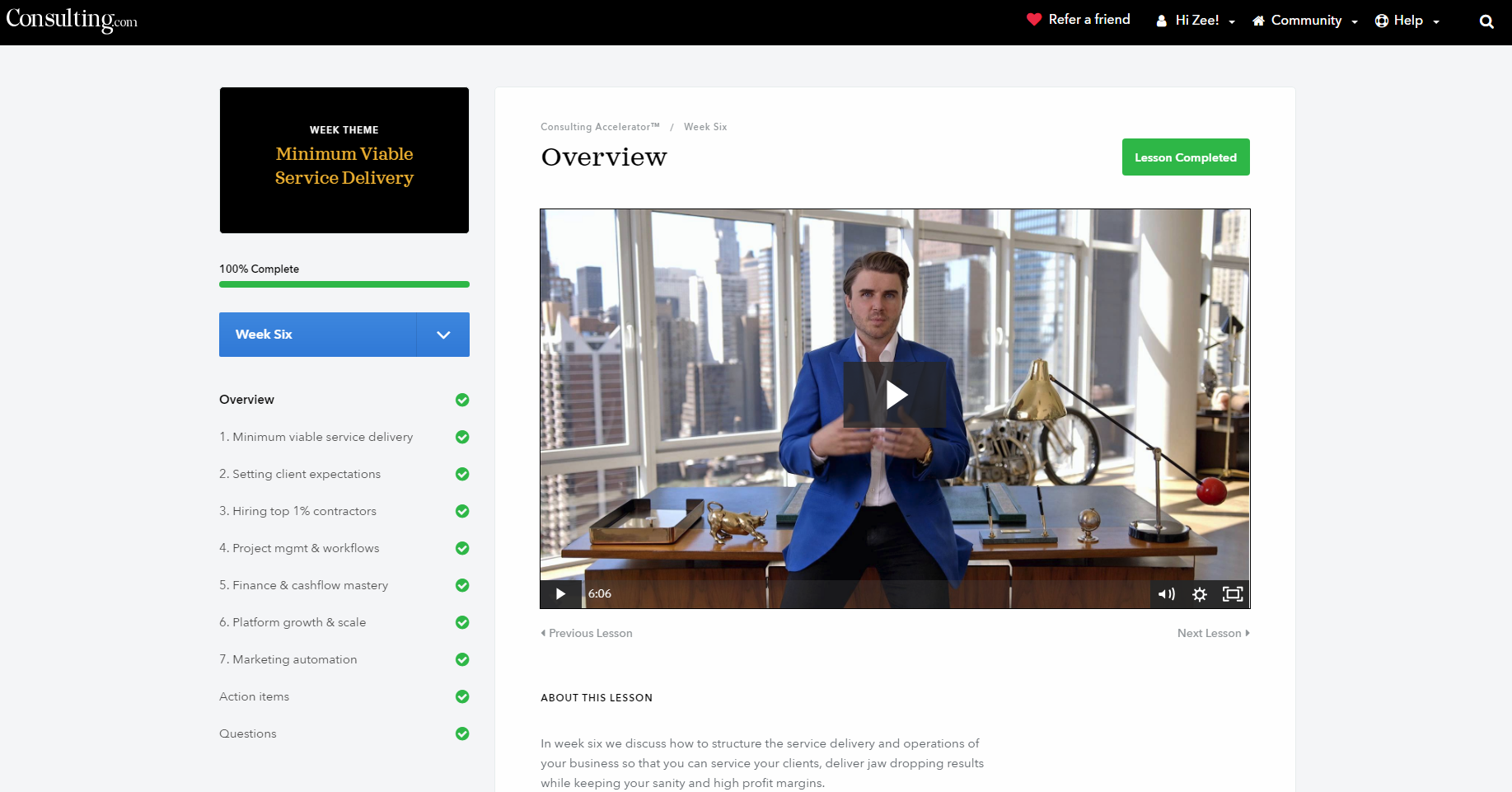
Week Six: Minimal Viable Service Delivery

W6

This is one of those weeks that almost no other course has. In week he focuses on the administrative/practice side of the business, including:

  • Refining your service
  • Asking for referral clients
  • Marketing automation
  • Hire contractors

In typical Sam fashion, he doesn’t just tell you that you need these things. There are details template that you tailor for your own business. This is incredibly help. Examples of what he provides are:

  • Services agreement
  • Onboarding survey
  • Contractors agreement
  • Simple financial tracking spreadsheet

Most of these are essential so I’d give it 4 hour of 5. Again some bits are little long.

Week Seven and Digital Marketing Bonus

What isn’t advertised is that Consulting Accelerator has a week seven and a bonus week.

W7

Week seven is based 3 webinars on whether another one of Sam’s program, Uplevel Consulting is for you. Uplevel is the program for those who has mastered a niche and wanting to productise their services.

DM Bonus

The Digital Marketing Bonus week is a rather basic week introducing what digital marketing is and should only be used in a pinch for those who really cannot find a niche.

Physical Box

Physical box

You get shipped a physical box containing the the workbooks right after you purchase the course (supposedly, mine wasn’t shipped immediate though – see below part on Support for more). These workbooks must have taken ages to prepare. All of Sam’s words and slides are contained within the workbooks. Apparently some people prefer to read these as opposed to watching the videos (not me, I much prefer the videos).

Also in the box are folder for your Alchemy of Self (week 2 mindset), Sam’s sales script (week 3), a daily planner and a notebook. The notebook feels a little cheap but the daily planner is helpful and I honestly think it should be sold as a separate product.

Facebook Group and Support

Facebook Group

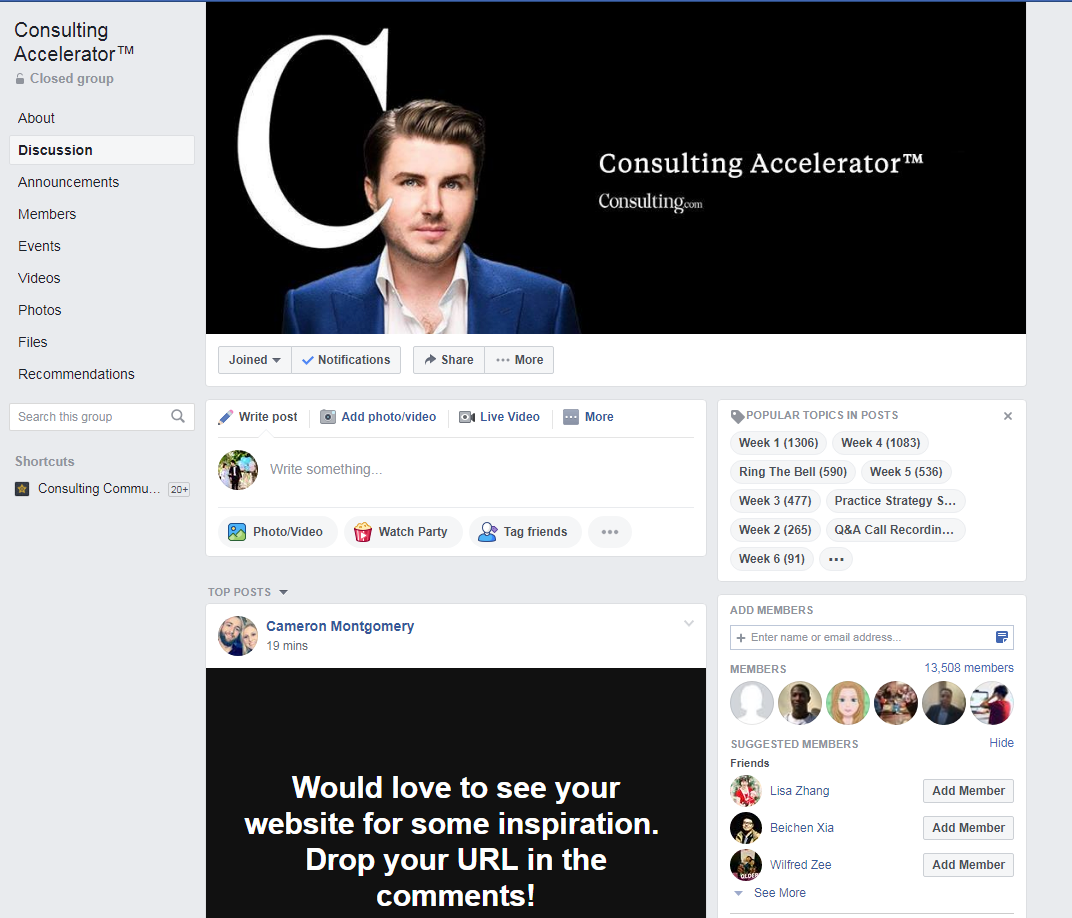
This course has one of the better Facebook groups I’ve seen. Group members are very active with people posting their client wins (or “ring the bell” as it is called in the group) and asking lots of questions. I’ve found it helpful not only as a place to ask questions when stuck but also getting encouragement from others when feeling a little down.

I haven’t had much to do with support except that my workbook wasn’t shipped after I purchased the course contrary to what was promised. I emailed support@consulting.com and received a reply within a few hours promising that my workbook will shortly be posted.

Is the Consulting Accelerator a Scam?

If you’ve read my review, you’ll know that I don’t think it’s scam.

Is it for everyone?

No, I don’t think so either. Doing what it contains is hard work and require dedication and single-minded focus. If you are willing to put in the sacrifices, this is likely to be the best course for starting an online business. Let me say that again, this course will make you uncomfortable and stretch you, and requires you to work lots in order to make it work. It does not generate instant results. So only buy if you are willing to do the work.

Sam’s students has allegedly created over 30 businesses turning over $1m thanks to his training. There are over 500 people who made over 6 figures from the course as well. So if you are willing to work it is possible. But working hard with no certainty of reward is not everyone. So tread your own path.

At the time of writing this review. Sam provides $500 discount on the course. If you do want to sign up after reading this, drop me a line here and I’ll save you $500.

Go back

Your message has been sent

Warning
Warning

Warning.